
Managing design and research through change
When the Product Design and User Research teams merged, I led both disciplines, overseeing a team as the business reset course.
I successfully supported the business and team when transitioning product strategy. This resulted in swift implementation of a new approach aimed at success and a future proofed workforce. While supporting staff through change, I also efficiently delivered numerous initiatives impacting on operations and revenue.
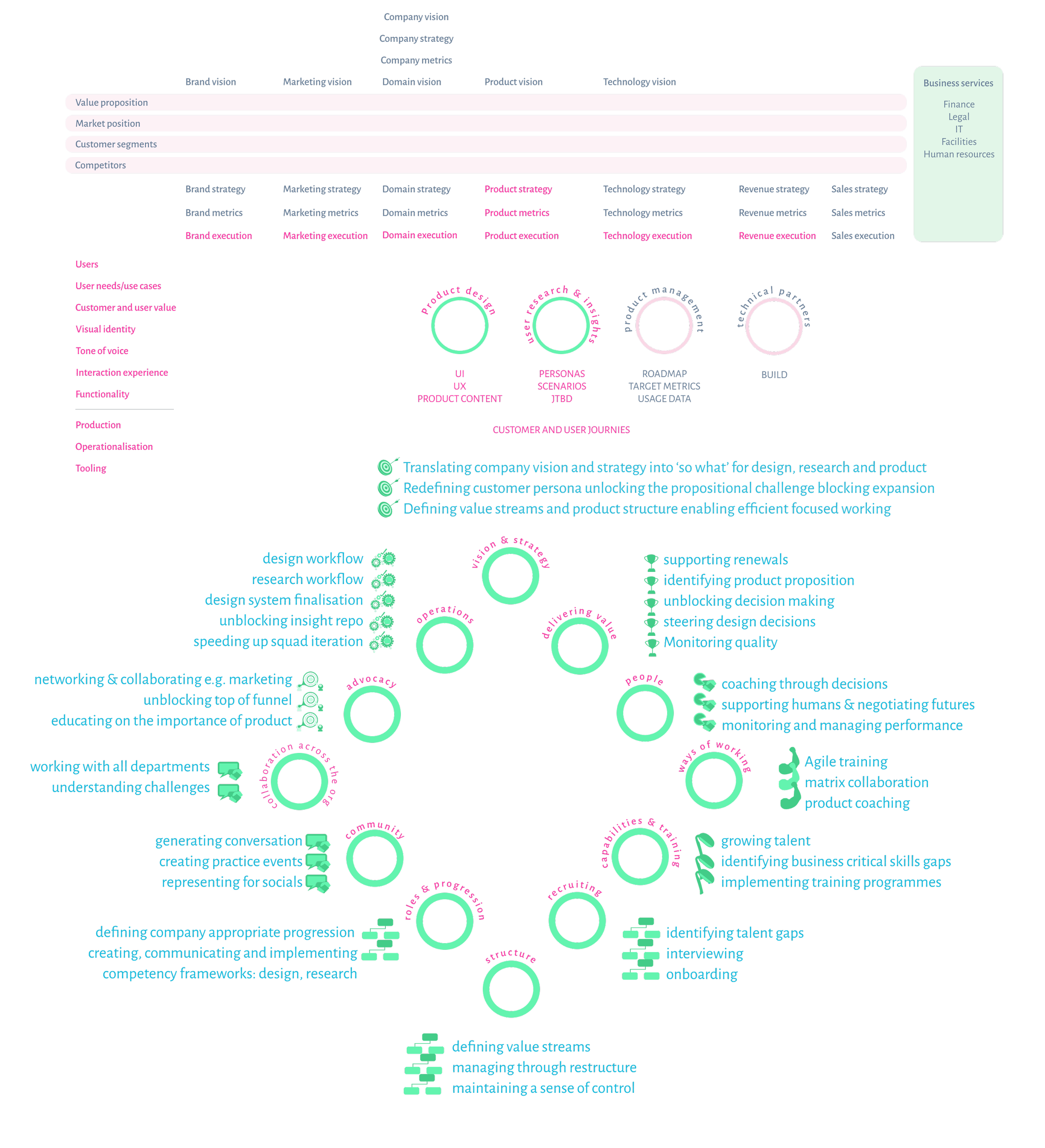
Mapping my role and the impact it had.*
In addition to setting direction and shaping the proposition within a B2B SaaS scaleup, I had the pleasure of leading and ensuring the working environment reflected the business need. Key moments that I am proud of are:
Managing and shaping a team at a time of great change resulting in a sustainable structure. Supporting the team through strain; where possible giving control.
Prioritising the rapid finalisation of the design system to ensure the development integration was accurate and complete.
Supporting designers through the transition into designing with AI by educating and demystifying.
Pragmatically unblocking the creation of an insights repository by focusing on getting started within existing tooling.
Generating clear user behaviour assets and reducing the gap between product teams and users to empower decision making.
Creating a program of training within the team that focused on addressing areas for improvement without the air of failure.
Speeding up and empowering product squads to create a roadmap of key features that directly generated revenue for the organisation in a single quarter time-frame. This was during a time were direction was difficult to achieve.
Generating a shared understanding and language amongst product, design, UX research and engineering teams on ‘how to build product’ through team coaching.
Finally, supporting wonderful colleagues through tough times and ensuring a future for all.
Core values drive my leadership approach
Measured Openness and Transparency: Everyone on the team explores a common goal, supporting towards outcomes with their individual strength. The approach is explored together, with rationale and motivation explored.
Balance of Control and Empowerment: I maintain a balance between giving team members autonomy and providing guidance through swift collaboration on lightweight documentation of processes, principles/heuristics and values. This generates shared understanding and an investment in standards without a top-down feeling.
Customer and User Centric Focus: Decision-making for design and research centres on customers and users, creating mutual value for both the company and those they serve.
Informed Decision-Making: We focus on facts, document decisions, and move forward without assigning blame.
Set the example and everyone contributes; be curious, be kind, chip in, pull your weight at all levels.
Mission alignment
When leading a capability, I focus on the mission that the team have within the company vision and strategy. I translate, discuss and document what is required into a ‘so what’ for the practitioners.
As director I set priorities on operations e.g. creation of self-serve assets such as core journeys, personas, design systems to release practitioners to focus on the high value work.
To ensure buy-in and alignment with stakeholders, I network and understand partner team priorities: engineering, sales and revenue teams.
Culture
A strong, positive team culture is essential to our success and well being. I empower the team to create this culture through facilitating quarterly workshops delivered using the philosophy of the Agile retrospective prime directive and, lead the implementation of initiatives designed to promote retention, business focus and build careers.

Informal activities, like team-led social events, help us build psychological trust and cohesion, which are the basics of a positive work environment. To create empathy amongst the team members I like to pair with different individuals to make these happen.
Communication
I prioritise clear, consistent communication through mediums such as:
Weekly updates: Identify dependencies and collaboration opportunities to avoid siloed thinking using a scrum of scrum model.
In-depth review sessions: Regular feedback and quality control discussions tailored to specific professions, such as design or research.
Weekly capability leadership syncs: Coordinate capability-level initiatives.
Quarterly retrospectives and goal-setting sessions: Focus on alignment with business objectives and capability growth.
Bi-weekly 1:1 conversations: Focus on individual performance, career development, and wellbeing. These include skip level and indirect report.
Quarterly career growth conversations: Address long-term goals, organisational alignment and personal aspirations.

Messages to the group focus on delivery and operations. Where any success has been achieved I share praise.
Messages to the individuals are focused on listening to them and their needs, which in turn mutually aids with individual retention and business focus. I lean heavily on my coaching background.
Framing and Structure
The structure of my team depends on the organisation's maturity and priorities.
Experience tells me that embedding practitioners with a product team drives success as it reduces delays in feedback loops. This positions the ‘home team’ or profession team as a secondary focus for the practitioner, empowering them to deliver. Attention is maintained on immediate value creation while having access, to specialist support, advice and constructive challenge. I believe this drives cross-functional success.
During this time of change and uncertainty I chose to expose the proposed value silos that the business required to the team. We collectively discussed the scope and vision for each area. I then gave the team some time to discuss pros and cons of each silo amongst themselves. After 8 iterations of team placement, during 1 working day, left the team feeling in control, comfortable and energised despite the business change. I mitigated any possible detachment from delivery.
Performance Management and Output Focus
I align the team’s goals with the company’s long-term strategy through the generation of the capability mission and initiative. This ensures that we understand how to contribute to business objectives without losing focus on excellence in our capability. I regularly assess the team’s capabilities by aggregating individual level conversations where I use my coaching skills to grow people. This gives me so much joy and fires up my personal momentum. Stakeholders and peers are consulted when setting quarterly goals making sure they support both business OKRs and personal development.
Process and Standardisation
I promote a shared understanding of team and business defined core principles and lightweight documentation to ensure consistency and quality. Operationalised workflows, design systems, and insight repositories help streamline our work as no human can remember or know all the things. I advocate for staff by providing training, tools, and a team budget to navigate uncertainty while fostering calm, and gradual cultural change.
Delivering Value
The privilege to deliver through other people is only granted if the team and business can see that they that value is all around. I thrive from understanding if what I’m doing is meeting with expectations and love to check in with everyone on whether they feel that is happening. Sometimes, when clients are full of praise this is obvious, sometimes, you need to seek out to make sure everyone feels heard and is supported.
Praise
“I’ve had the pleasure of working with Aoife. She wasn’t just a sounding board for ideas—she truly helped me grow by offering thoughtful guidance and challenging me to think more strategically. She knew exactly when to provide support and when to encourage me to find my own solutions, offering practical and actionable advice along the way. Her insightful questions pushed me to think more critically, and she consistently brought out the best in me.On top of all that, she’s such a warm and positive person to work with, making our collaboration even more enjoyable. I’m really grateful for everything I learned from her!”
*thank you to my good friend Martina for sharing her thinking the structure of directorship